Assoc. Prof. Dr. Ayhan Işık Erdal, MD, FACS, FEBOPRAS — double board-certified plastic surgeon with 15+ years of experience. Tummy tuck with muscle repair, low bikini-line scar and natural belly button reshaping — individualised to your anatomy, skin-fat excess and body goals.
Every abdominoplasty is individually planned based on your skin-fat excess, muscle diastasis, scar preferences and body proportions. Dr. Erdal's approach prioritises a flat, defined abdominal contour with a natural belly button, the lowest possible scar hidden in the bikini line, and a safe, efficient recovery.
Selection is driven by your anatomy, not by fashion. Mini for limited lower-abdominal laxity. Standard as the workhorse for classic post-pregnancy cases. Extended when flank laxity is part of the problem. Fleur-de-lis for significant weight-loss cases with vertical as well as horizontal skin excess.
When the rectus abdominis muscles have separated — after pregnancy, weight change or longstanding laxity — Dr. Erdal plicates them with internal sutures to reconstruct the natural abdominal wall. This is what creates a genuinely flat profile and a defined waist, not just a skin reduction.
When indicated, liposuction of the flanks, waist and/or upper abdomen is combined with the tummy tuck in one anaesthetic. This addresses areas a pure abdominoplasty cannot reach, producing a more defined waist and a smoother, more athletic torso.
The main incision is planned and drawn with you the day before surgery, aiming to sit inside your preferred underwear or swimwear line. Where possible, an old C-section scar is incorporated into the new incision so you don't end up with multiple lines.
A small, vertical-teardrop umbilicus blended discreetly into the new abdominal contour — avoiding the over-large, ring-shaped or obviously sutured belly buttons that give away a poor tummy tuck.
Dr. Erdal holds FACS and FEBOPRAS fellowships, with 30+ peer-reviewed publications. He combines surgical expertise with an evidence-based approach to body contouring.
Every abdominoplasty is a combination of decisions. Here is what Dr. Erdal evaluates for you — and why each matters.
Assessed from the costal margin (ribs) to the pubic area. How much loose skin sits above the belly button, how much below, and how much subcutaneous fat is present. Classified using the Matarasso system — Type I (mild) to Type IV (severe) — which directly determines whether a mini, standard, extended or fleur-de-lis technique is indicated.
Separation of the vertical abdominal muscles — common after pregnancy or significant weight change. When present, internal plication sutures bring the muscles back together, creating a flat profile and a defined waist. This step is often the difference between an "OK" and an "excellent" tummy tuck result.
A mini scar is short and confined to the central lower abdomen. A standard hip-to-hip scar follows the bikini line. An extended scar continues onto the flanks. A fleur-de-lis adds a vertical line for massive weight-loss cases. The shortest scar appropriate for your anatomy is always chosen.
In a standard or extended abdominoplasty, the umbilicus is detached from the skin, left attached to the abdominal wall, and brought out through a new opening once the skin has been repositioned. A vertical-teardrop shape produces the most natural result. Mini abdominoplasty leaves the belly button untouched.
Pure abdominoplasty cannot sculpt the flanks, waist or upper abdomen — only tighten and remove. When a more defined silhouette is part of your goals, liposuction is added in the same operation (lipoabdominoplasty), using a technique that preserves the blood supply to the repaired abdominal skin flap.
A tummy tuck is commonly combined with breast surgery as a mommy makeover in patients who have completed their family. Combination is safe when total surgical time, blood loss and anaesthetic burden are within appropriate limits. Dr. Erdal evaluates suitability individually during consultation.
The Matarasso classification is the most widely used system for planning abdominoplasty. It matches the degree of skin-fat excess and muscle diastasis to the appropriate technique. Understanding your type helps set realistic expectations before consultation.
Slight skin laxity, no significant fat excess, no muscle diastasis. Contour is fundamentally good.
Laxity and mild fat excess confined to below the belly button. Minimal or no muscle diastasis.
Skin and fat excess above and below the umbilicus with mild-to-moderate muscle diastasis.
Significant skin-fat excess and marked muscle diastasis. Often after multiple pregnancies or major weight loss.
The Matarasso classification is a clinical guide, not a rigid rule. The final technique depends on skin quality, weight stability, scar preferences and whether liposuction is also being added. Your consultation will clarify which type applies to you and which technique is most appropriate.
Dr. Erdal selects the abdominoplasty technique individually for each patient based on the Matarasso type, muscle diastasis, scar preferences and body goals. In his practice, standard (full) abdominoplasty and extended abdominoplasty with flank liposuction are the two most frequently performed techniques — but the best option is always the one tailored to you.
Shortest incision, limited to the central lower abdomen. No umbilicus repositioning. Suitable for Matarasso Type II — mild laxity below the belly button only, with minimal or no muscle diastasis.
The workhorse technique. Horizontal hip-to-hip incision placed low within the bikini line, with belly button repositioning and full muscle repair. Addresses the entire abdomen from the rib cage to the pubic area.
Standard abdominoplasty with the scar extended onto the flanks to address hip and lower-back laxity. Typically combined with flank liposuction (lipoabdominoplasty) for a defined waist.
Combines a horizontal low-abdominal incision with a vertical midline incision to address both horizontal and vertical skin excess. Reserved for massive weight-loss patients with significant skin redundancy in both directions.
The "Most Frequently Performed" label reflects the two techniques Dr. Erdal uses most often in his practice — not a universal preference. Every case is evaluated individually, and your anatomy decides which pattern is safest and most effective for you.
A tummy tuck scar is not finished when the stitches come out. It evolves over 12–24 months, passing through predictable stages. Understanding the timeline helps set expectations and shows why consistent scar-care during the first year is so important.
Incision is red, slightly raised and firm to touch. Taping and the compression garment are critical. Drains are removed at 7–14 days; sutures dissolve or are removed.
Scar may peak in redness and firmness around months 2–4, then begin to soften. Silicone tape or gel is started. Sun protection is essential — UV makes young scars darker permanently.
Scar flattens and lightens from red to pink. Gentle scar massage improves pliability. Most patients see a marked aesthetic improvement month by month.
Scar reaches its final appearance — typically a fine, pale line. Further minor improvement may continue until 24 months. Final assessment of the result is made at this stage.
Tummy tuck recovery has a well-defined trajectory. Knowing what to expect at each stage — and what is abnormal — makes the process dramatically smoother. The milestones below are a guide; your own recovery will track close to but not exactly on these.
Surgery takes 3–5 hours depending on the technique and whether liposuction is added. You spend 1–2 nights in the hospital with nursing care, pain control, DVT prophylaxis and early mobilisation. Most patients are up and walking the evening of surgery — slightly bent forward at the waist to protect the repair.
You return to your suite at Antwell, with daily check-ups by Dr. Erdal's team at the ground-floor clinic. The compression garment is worn day and night. Walking frequency is gradually increased. Most discomfort is manageable on oral analgesics by day 3–4. Sleeping is in a semi-reclined position (pillows under knees and back).
Drains are removed (usually painlessly) when output drops below threshold — typically 7–14 days. Upright posture returns progressively as the muscle repair settles. A final check-up with Dr. Erdal clears you to fly home. Most international patients return home at day 7–10.
Most patients can return to sedentary office work by the end of week 2 or during week 3. Fatigue is still present and naps may be needed. No lifting above 5 kg. Gentle walking is encouraged daily. The compression garment continues day and night.
Low-impact activity (longer walks, stationary bike with permission) is gradually reintroduced. Most swelling is resolving; the initial shape of your new abdomen is emerging. Scar-care with silicone tape or gel should be well established. Driving typically resumed by week 3–4 when off pain medication.
Running, strength training and core exercises are cleared at week 6–8, depending on how the muscle repair has healed. Core work is reintroduced gradually, never to pain. The compression garment can usually be switched to daytime-only or discontinued.
The final abdominal shape continues to refine as residual swelling resolves. Scars enter the remodelling phase and begin to lighten. Most patients feel their "new normal" by month 3; the aesthetic result at 6 months is very close to what you will have at 12 months.
Scars reach their final, faded appearance by 12–18 months and may continue to refine until 24 months. The abdomen is fully settled, muscle repair fully integrated, belly button scar typically inconspicuous. Long-term maintenance is about stable weight, core strength and good posture.
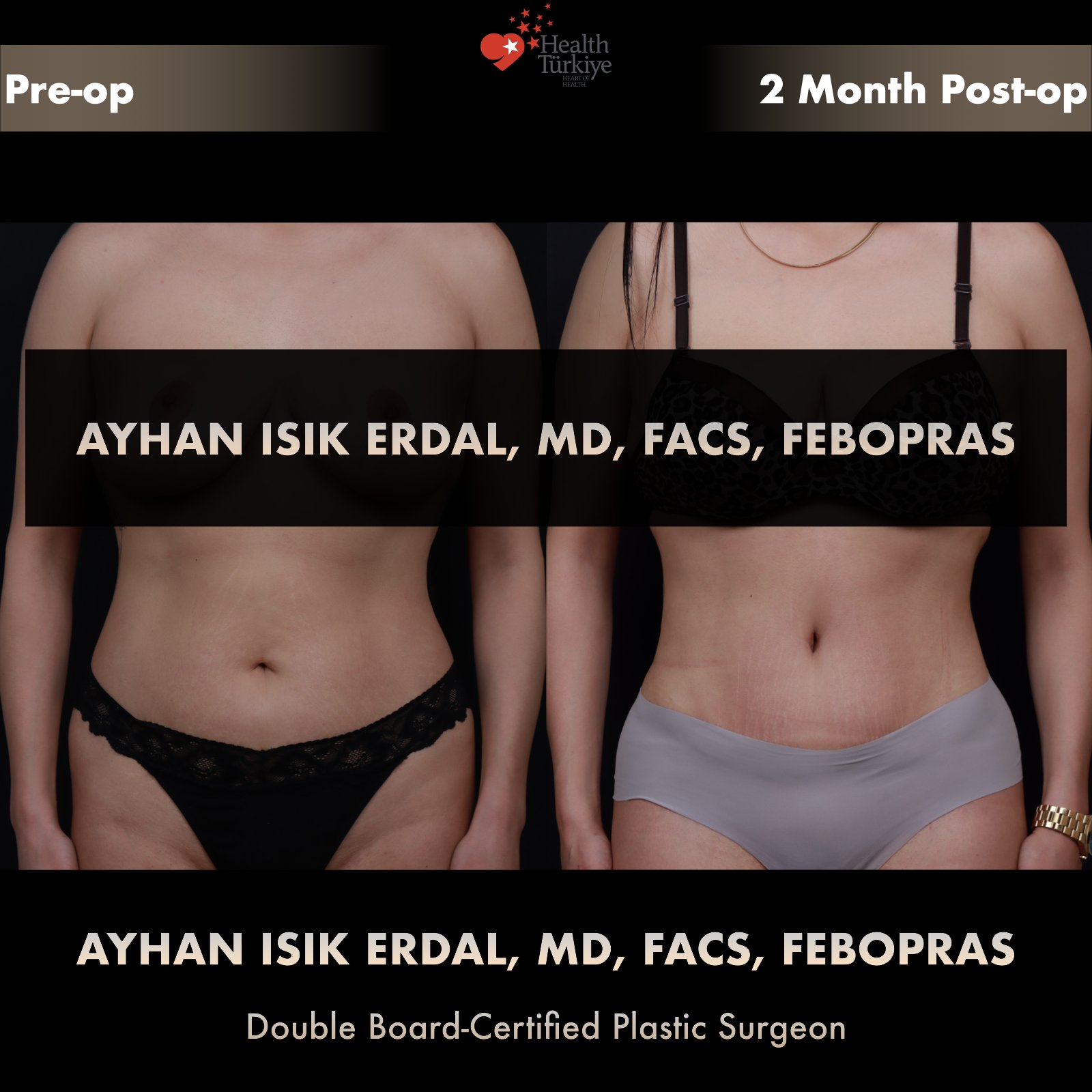
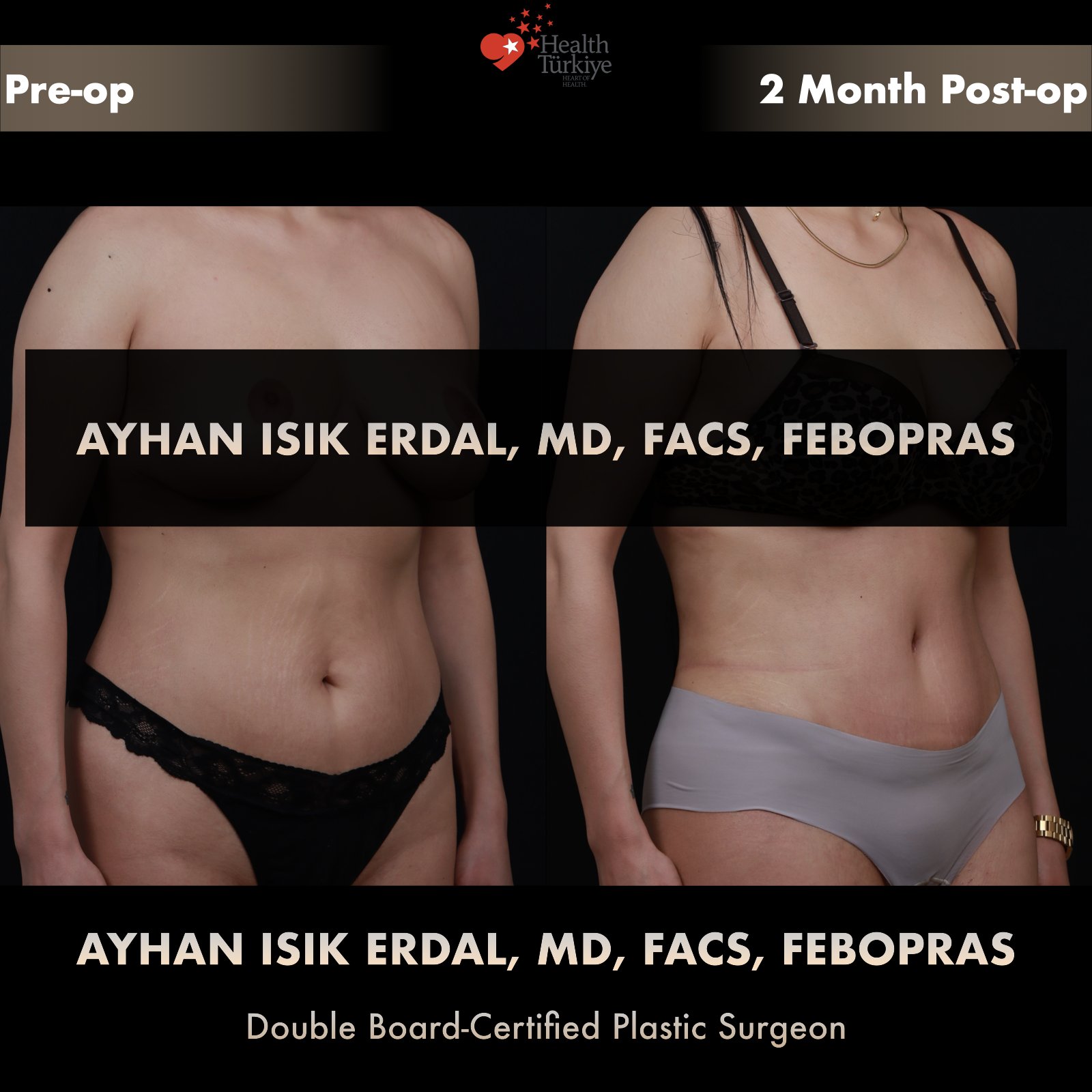
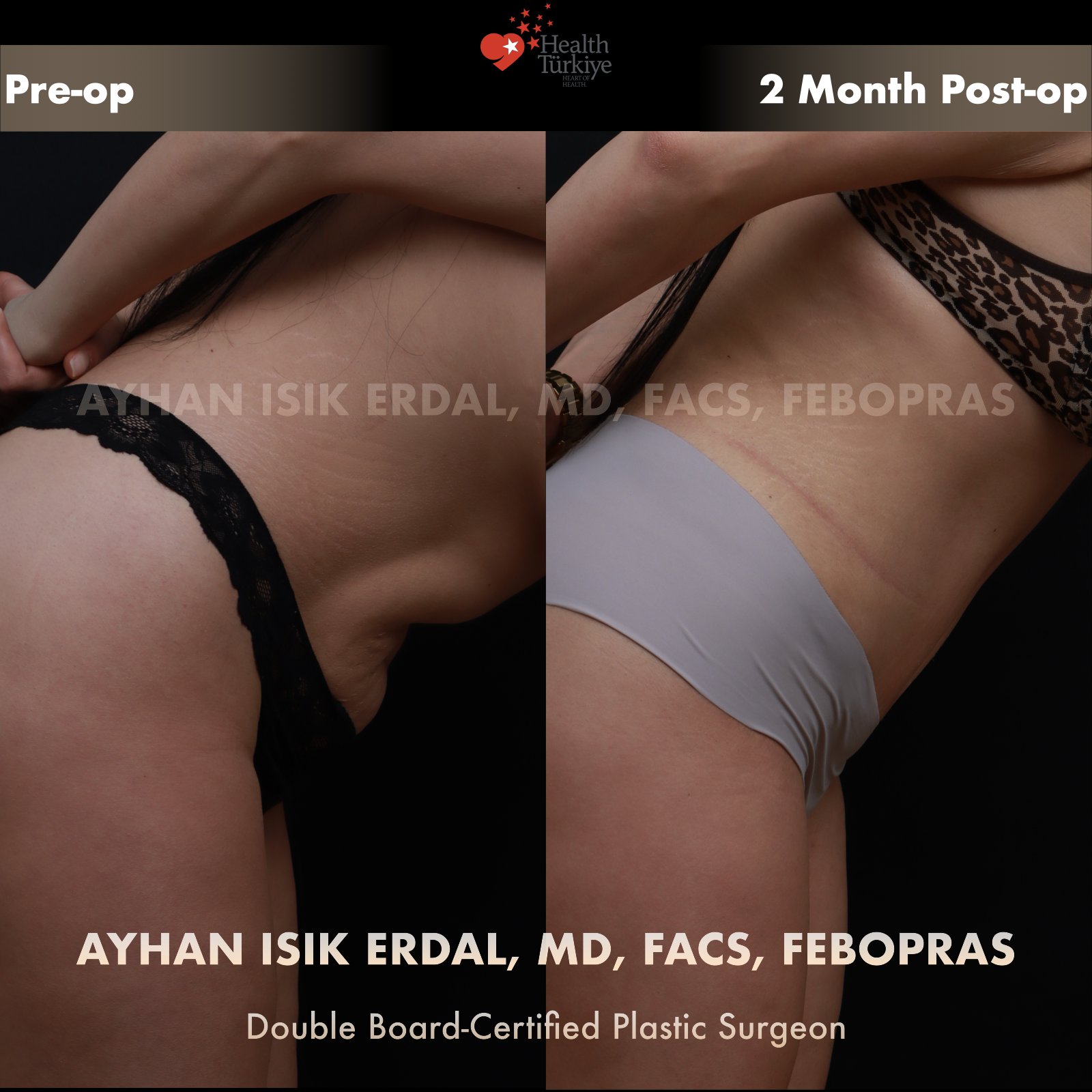
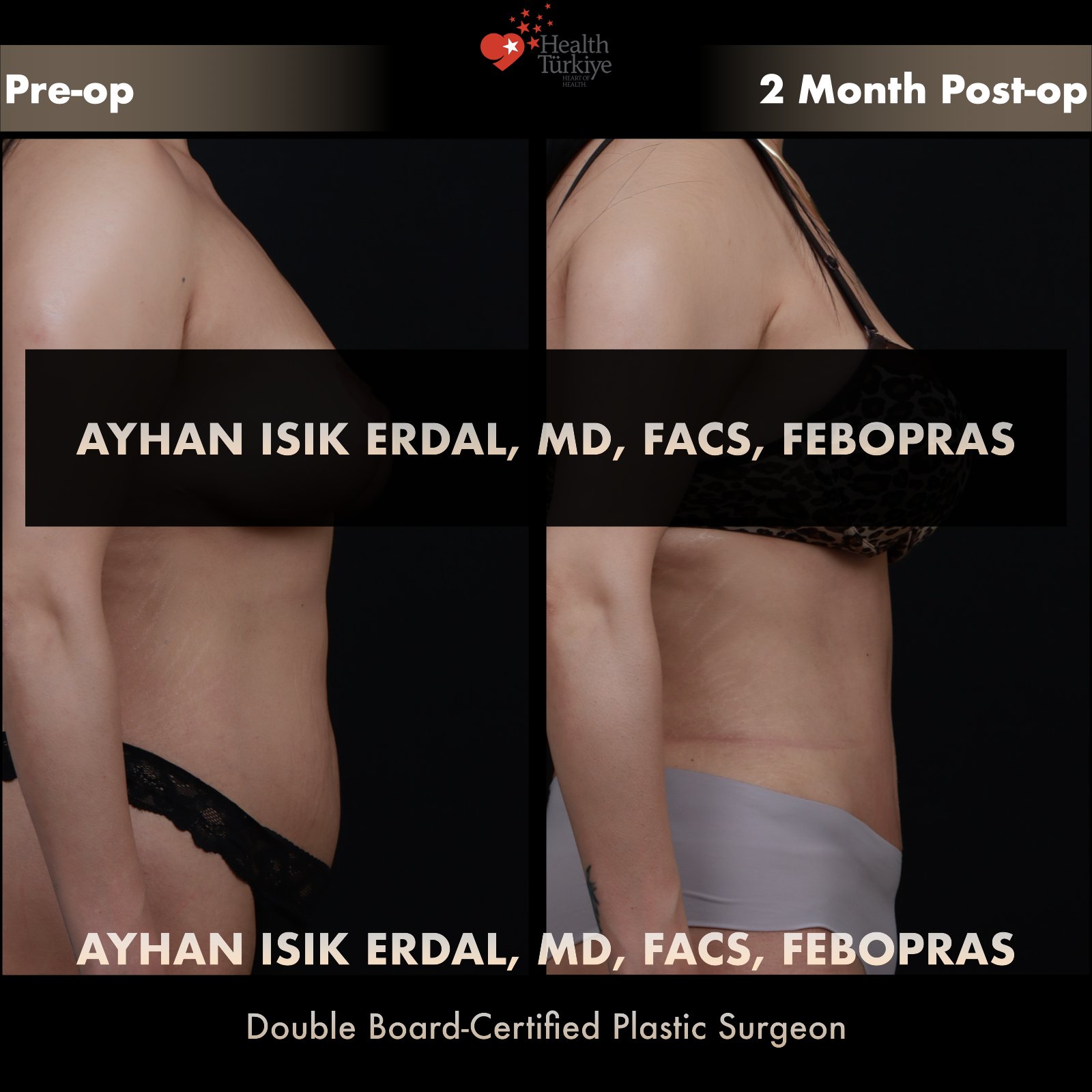
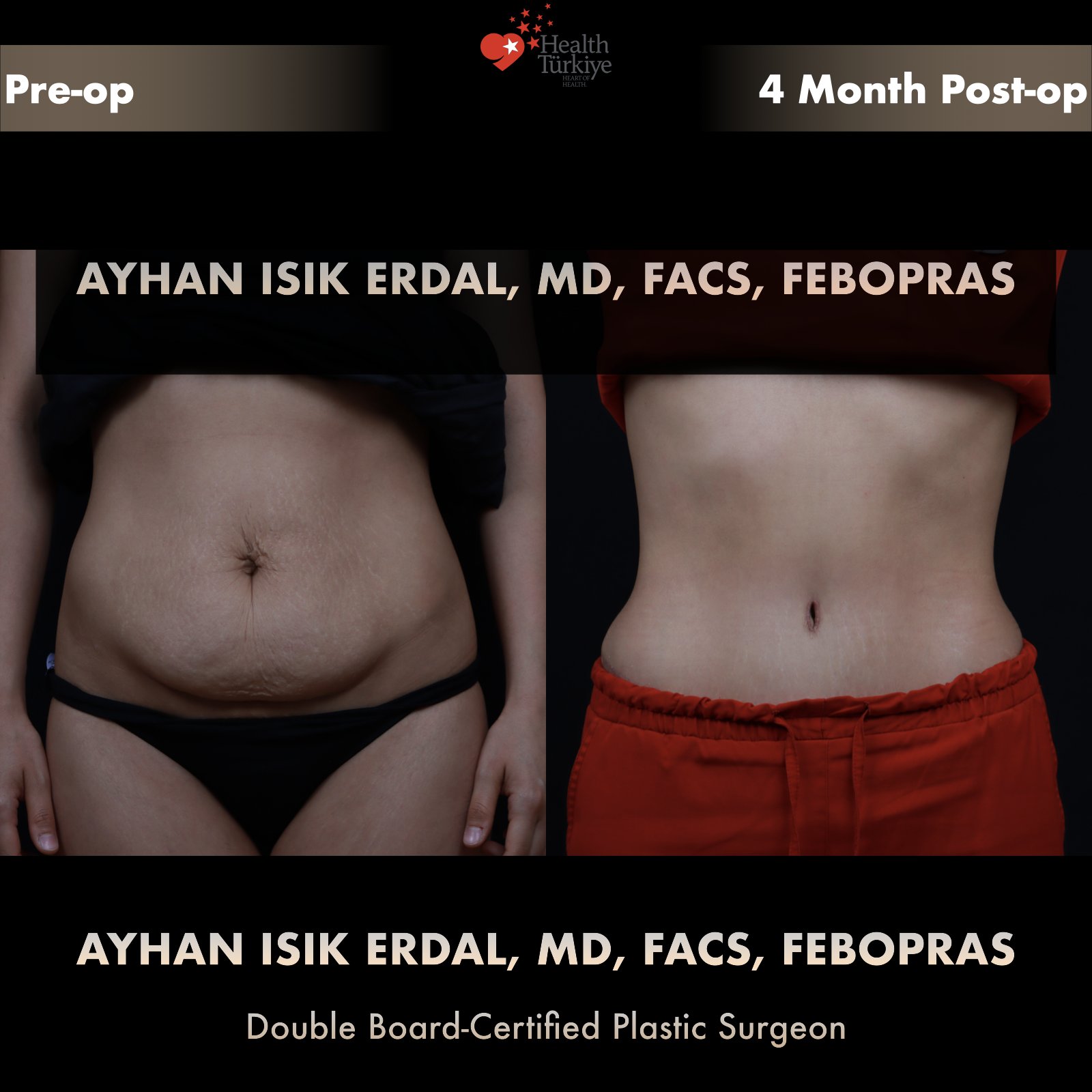
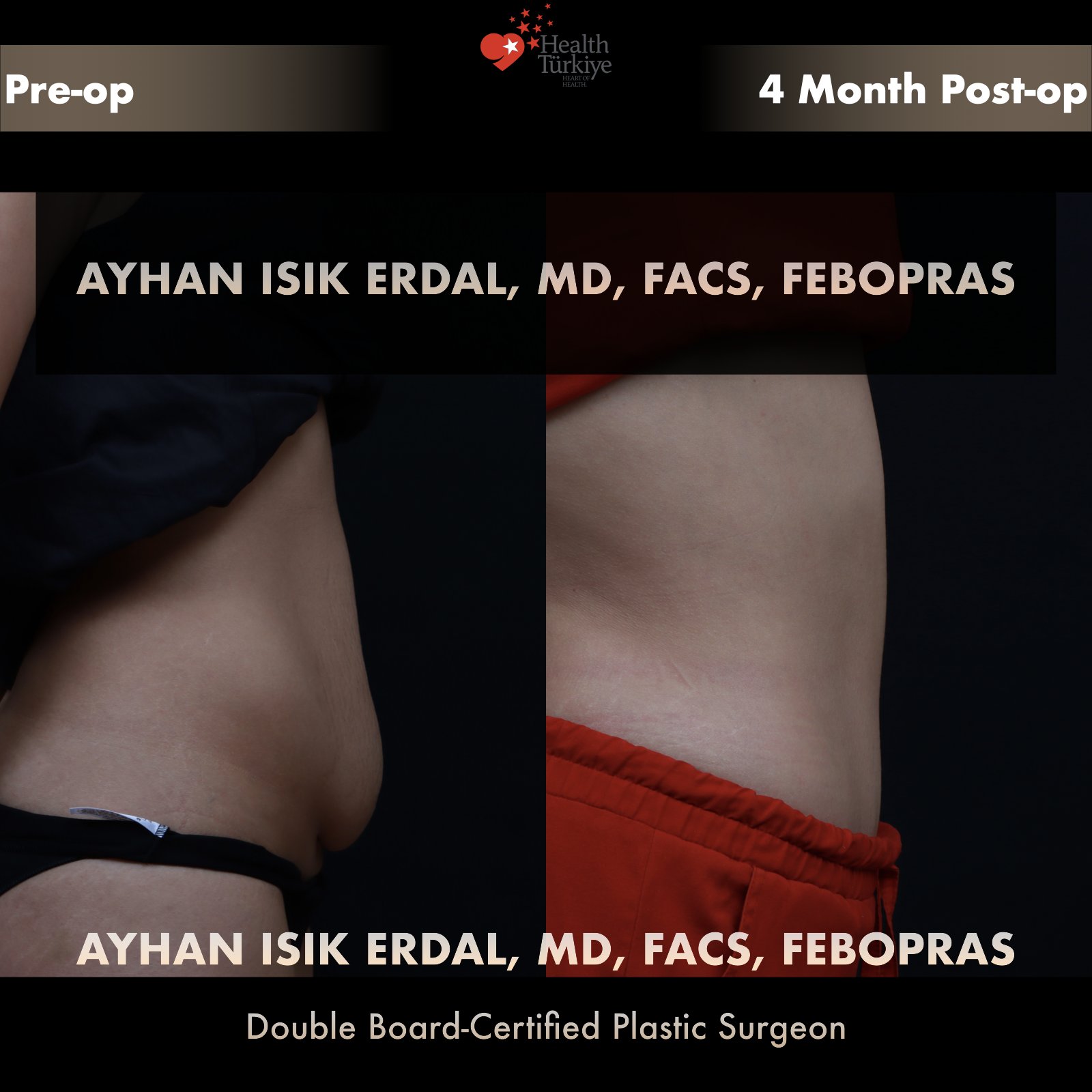
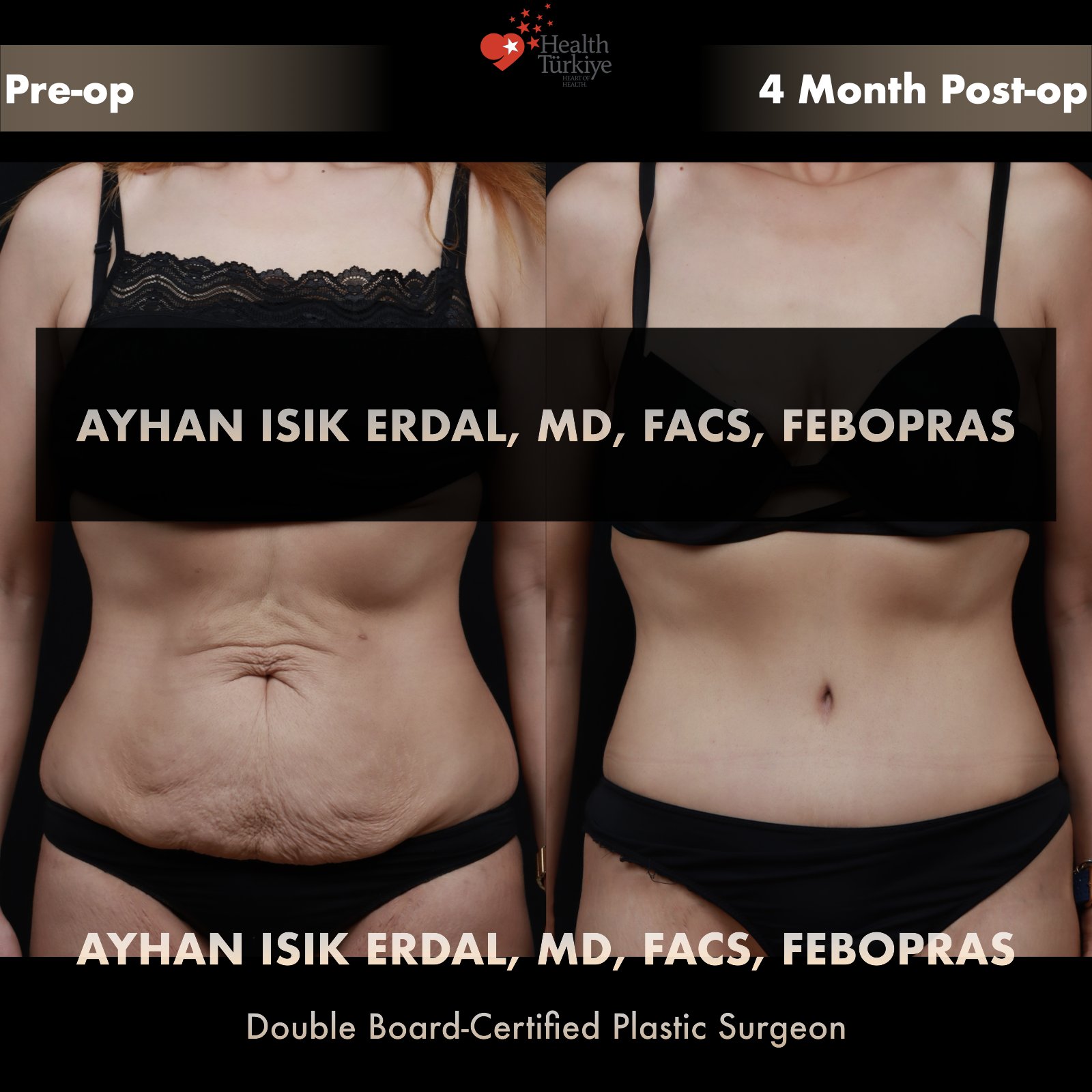
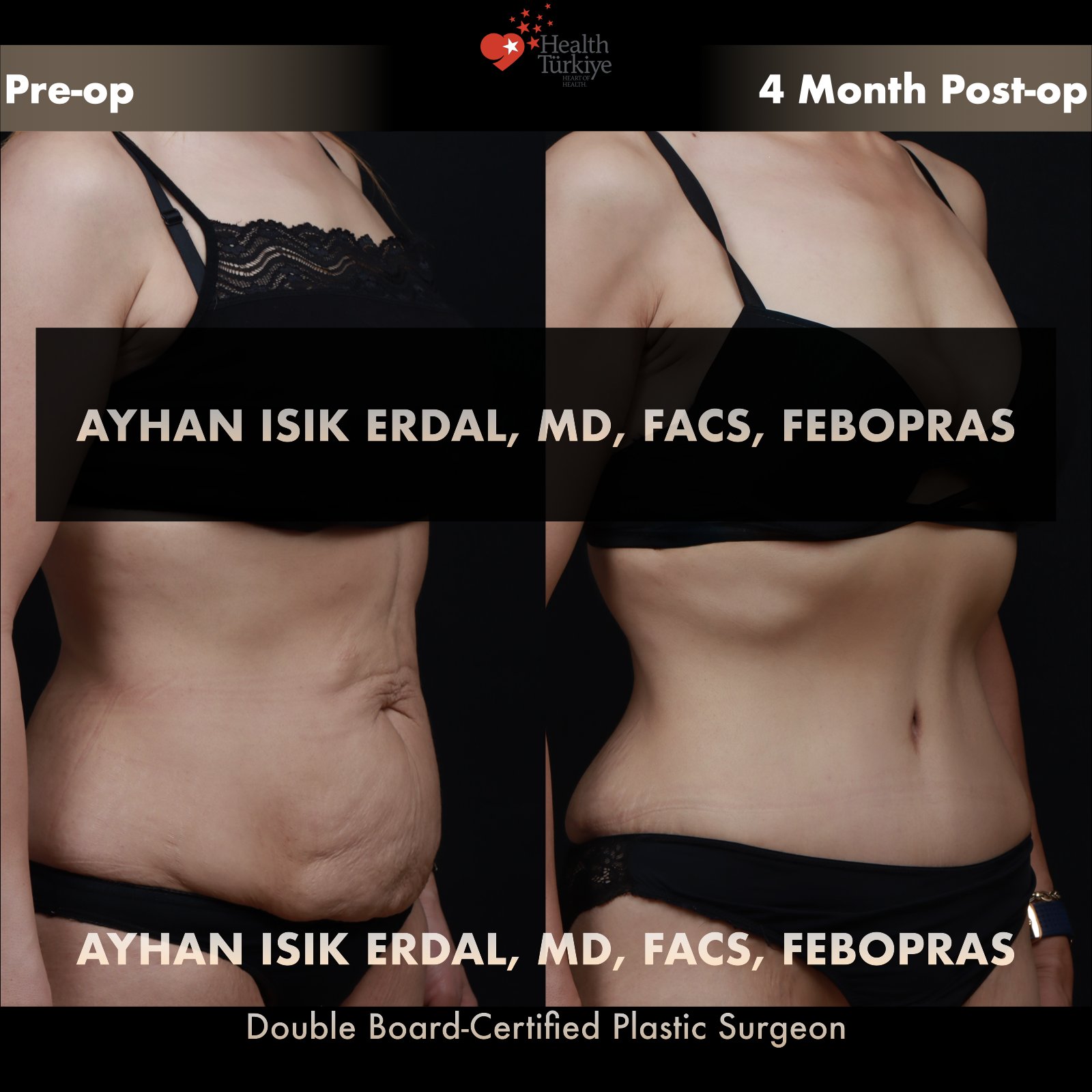
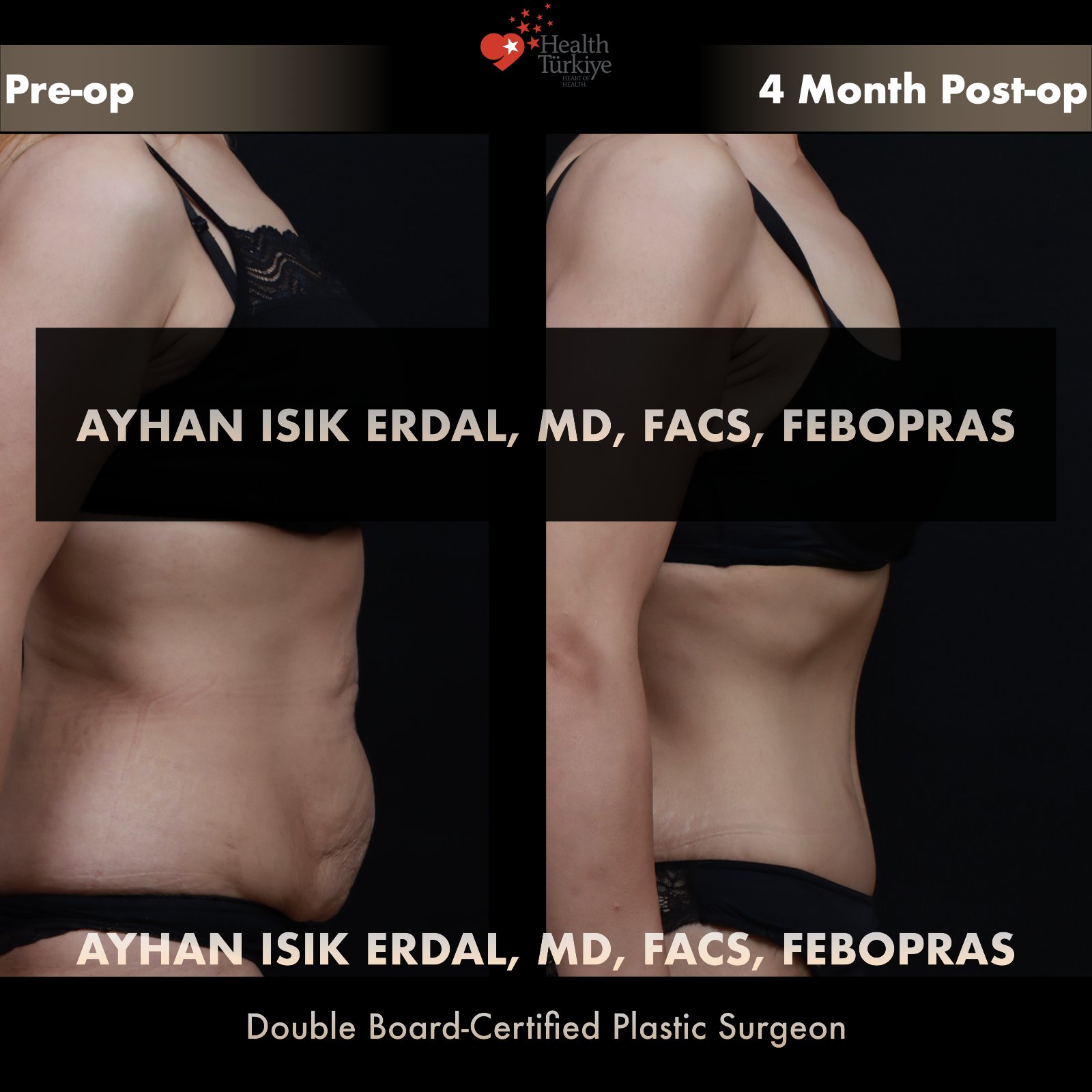
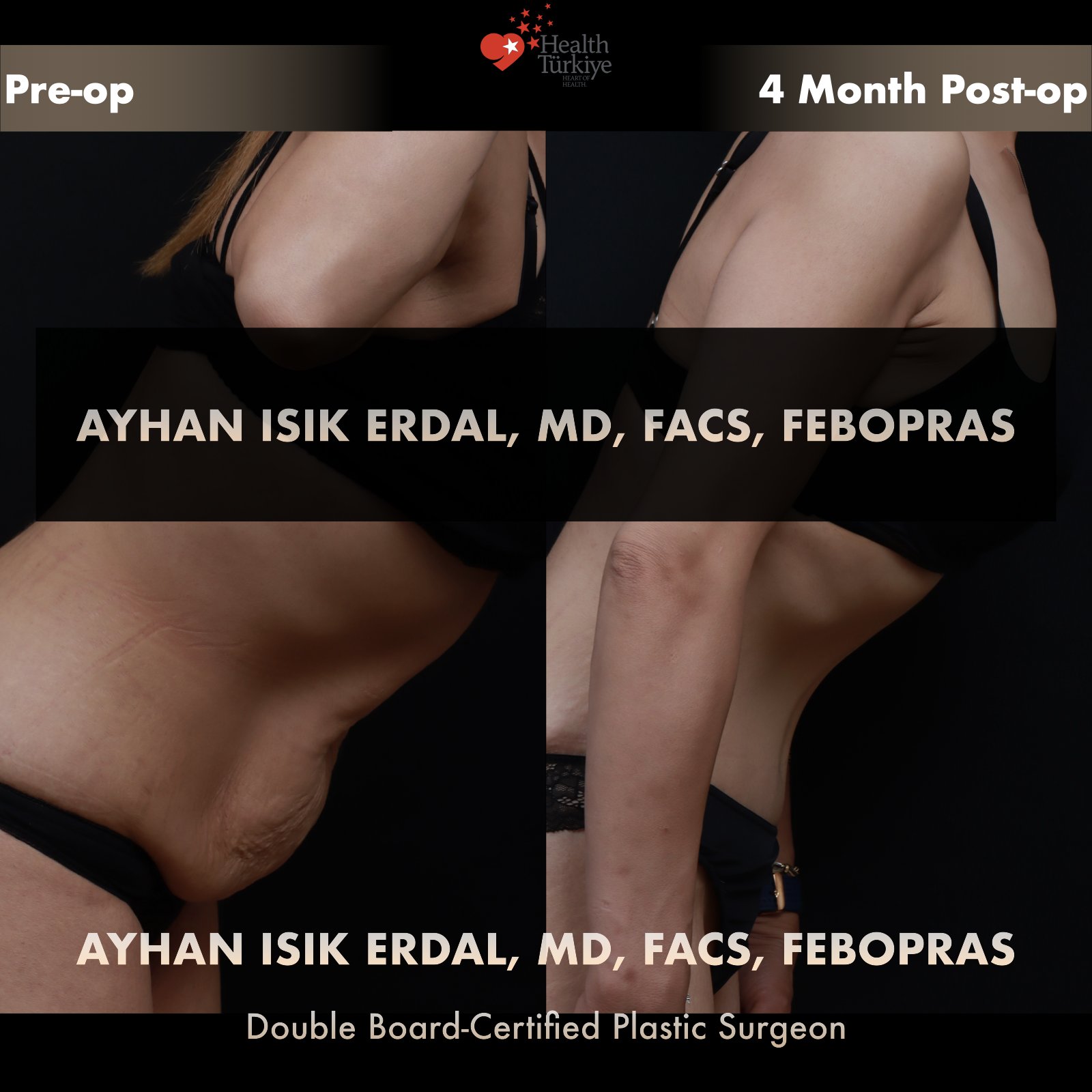
Tummy tuck results by Assoc. Prof. Dr. Ayhan Işık Erdal. Each panel below is a side-by-side pre-operative and post-operative comparison at the stated time point. Patient identities are protected — faces and chest area are always covered. Tap any image to enlarge.


All patient photographs published with explicit written consent. All cases performed by Assoc. Prof. Dr. Ayhan Işık Erdal. More cases from the full range of techniques — extended, fleur-de-lis, lipoabdominoplasty and mommy makeover — are being added. Individual results vary; your consultation will clarify what is realistic for your anatomy and Matarasso type.
Every international patient receives a fully coordinated experience — not just surgery, but a seamless journey designed around the specific demands of tummy tuck recovery.
Share your photos (standing frontal, both oblique views and lateral, arms slightly away from the body), along with your height, weight, pregnancy and weight-change history, via WhatsApp or the contact form. Dr. Erdal personally reviews your case. A free video consultation is scheduled within 24 hours. You'll receive a personalised recommendation — Matarasso type, technique (mini / standard / extended / fleur-de-lis), scar plan, whether liposuction is advised, and realistic outcome.
You receive a clear, all-inclusive quote with no hidden costs. Surgery fee, hospital stay (1–2 nights), anaesthesia, pre-operative tests, compression garment, drains, medical tapes, scar-care kit and all follow-ups are covered. Liposuction, if added, is quoted separately and transparently. No surprises on the day.
A private transfer meets you at Istanbul Airport upon arrival and takes you directly to your accommodation. No taxis, no stress, no language barriers.
We coordinate your stay at Antwell Suites İstanbul — a premium recovery-friendly residence close to the clinic, with full kitchen, separate bedroom, and a large, easy-to-navigate bathroom. Particularly important after a tummy tuck, since you'll be walking slightly bent forward for the first days.
The day before surgery: comprehensive pre-operative blood tests at an A+ accredited hospital, anaesthesiology consultation, and an in-person consultation with Dr. Erdal — including pre-operative marking of your scar line (drawn with you standing so it sits correctly within your underwear) and final discussion of your surgical plan.
Tummy tuck performed by Dr. Erdal under general anaesthesia at an A+ accredited hospital. Surgery typically takes 3–4 hours for a standard abdominoplasty, 4–5 hours with liposuction (lipoabdominoplasty), and up to 6 hours for a mommy makeover. One to two nights hospital stay is included with full monitoring, pain control and DVT prophylaxis.
Daily check-ups with Dr. Erdal's team at the ground-floor clinic during your stay. Compression garment fitted, wound checks, drain monitoring and personalised recovery guidance at each visit. Drains removed at 7–14 days (usually painlessly) once output drops below threshold. Your compression garment, medical tapes and scar-care starter kit are provided free of charge.
Most tummy tuck patients fly home on day 7–10, after drains are out and a final check-up with Dr. Erdal. Detailed aftercare instructions are provided, including a full scar-care protocol for the 12–24 month maturation window, plus DVT prevention advice for the flight (compression stockings and in-flight exercises). If you'd like to stay longer, Istanbul is a wonderful city to explore. After returning home, photo & video follow-ups are scheduled at 1 month, 3 months and 1 year, with unlimited WhatsApp support throughout.
Premium 1+1 suites designed for recovery comfort, minutes from the clinic
🤝 Companions are strongly encouraged after tummy tuck. Mobility is limited in the first 7 days — you'll be walking slightly bent forward, and routine tasks like bending, reaching high shelves and getting in/out of bed benefit from a second pair of hands. Your companion stays in the same 1+1 suite with you and uses the VIP transfer vehicle — at no extra charge.
Assoc. Prof. Dr. Ayhan Işık Erdal
MD, FACS, FEBOPRAS · Plastic, Reconstructive & Aesthetic Surgery
"A good abdominoplasty is not just about removing skin. It is muscle reconstruction, contour design and a scar that disappears into your bikini line. The difference between an acceptable result and an excellent one is in every one of those details."
— Assoc. Prof. Dr. Ayhan Işık Erdal, MD, FACS, FEBOPRAS
From your very first inquiry to your 12-month follow-up, our team ensures you feel fully supported at every step. Our clinic coordinator personally manages all international patient communication — consultation scheduling, travel guidance, and ongoing remote follow-up after you return home.
All communication is conducted in English. We respond to WhatsApp and email inquiries within 24 hours, seven days a week. No third-party agencies — direct surgeon communication at every stage.
Dr. Erdal is an active researcher with work published in Annals of Plastic Surgery, Aesthetic Surgery Journal, Facial Plastic Surgery, Plastic and Reconstructive Surgery and ISAPS journals. Academic research informs surgical decisions — and vice versa.
All reviews sourced directly from Google. 4.9 stars · 45 verified reviews.
"As someone terrified of surgery, choosing Dr. Erdal was the best decision of my life. From the very first consultation, the confidence he gave me left all my fears behind. I am incredibly happy with my results — natural and exactly what I hoped for."
"I had an excellent experience and couldn't be happier with the entire process and results. From the first consultation, I felt listened to, understood, and genuinely cared for. The results look natural, balanced, and exactly what I hoped for — better than I imagined. A true artistic eye."
"Dr. Erdal is incredibly attentive both before and after surgery. A surgeon with whom you will feel completely safe. He explains the entire process in detail beforehand. His clinic is bright and beautiful. I highly recommend him."
"Dr. Erdal performed my surgery 2.5 years ago. I am truly satisfied with both the result and his care. Despite being an anxious person, he patiently answered all my questions. The result is very natural and suits my body perfectly."
"I met Dr. Erdal and simply said 'I trust you completely.' Not a single person has guessed I had surgery. He is a master of his craft — patient, warm, and exceptional. The result changed my confidence entirely."
"Everything from consultation to post-op was perfectly organized. The hospital was modern and clean. Dr. Erdal's calm and professional demeanor made me feel safe throughout. Absolutely worth travelling to Istanbul for."
In-depth guides written by Dr. Erdal to help you make an informed decision.
Our team responds within 24 hours. Send photos (standing frontal, oblique and lateral views) directly via WhatsApp for the fastest initial assessment. Free video consultation available.
We respond within 24 hours. Your information is kept strictly confidential.
Dr. Erdal's clinic holds the official International Health Tourism Authorization Certificate issued by the Republic of Turkey Ministry of Health — ensuring quality, safety and legal compliance for international patients.
Certificate No: 2026034015610080000444996 · Issued: 10.03.2026 · Republic of Turkey Ministry of Health, General Directorate of Health Services